

Commercial Disruption Alert - 10 Sept 2026 - East Asian Ports
Repeated typhoons disrupt East Asian ports, delaying vessels and weakening schedule reliability.
Repeated typhoons disrupt East Asian ports, delaying vessels and weakening schedule reliability.

Mundra strike ends, but container backlogs and logistics disruption may persist temporarily.
Dover protest blockades expose freight vulnerability across critical UK Channel port access
Energy security requires strategic redundancy, diversified corridors and shared infrastructure to withstand interconnected maritime disruption.


The strategic assumptions upon which global energy security has rested for decades are no longer sufficient to explain the emerging realities of today’s geopolitical environment. For decades, the prevailing objective has been to safeguard the maritime chokepoints upon which international hydrocarbon trade depends. The Strait of Hormuz, Bab el-Mandeb and the Suez Canal have consequently been treated as discrete strategic gateways whose uninterrupted operation could be preserved through naval power, freedom of navigation operations and regional security partnerships.
Recent developments, however, suggest that this approach, while remaining indispensable, is no longer sufficient. These waterways can no longer be understood as isolated chokepoints but as interconnected components of a wider strategic system, where disruption or coercion affecting one route rapidly alters the strategic significance of the others. The vulnerability of the global energy system therefore derives not only from the importance of individual maritime passages, but increasingly from their strategic interdependence.
Amb. Prof. Mohamed A. Qubaty examines how interconnected pressure on Hormuz and Bab el-Mandeb strengthens the case for alternative energy routes and the ASTRA corridor.
Read the full analysis →This changing strategic environment demands a corresponding shift in strategic thinking. The central question is no longer simply how to defend vulnerable maritime geography, but how to reduce structural dependence upon it. In an era of interconnected maritime coercion, resilience can no longer be measured solely by the ability to protect existing routes. It must increasingly be judged by the capacity of the wider energy system to absorb disruption without suffering systemic failure. The challenge is therefore no longer simply to protect vulnerable maritime chokepoints, but to ensure that the wider energy system can continue to function even when they are subjected to sustained strategic coercion.
None of this diminishes the continuing importance of protecting critical maritime routes. Naval deterrence, maritime surveillance and freedom of navigation operations remain indispensable instruments for preserving stability and reducing the likelihood of disruption. Yet even the most effective deterrence cannot eliminate the structural vulnerabilities created when a substantial proportion of global energy flows remains concentrated within a limited number of geographically constrained maritime corridors.
The strategic objective, therefore, should not be to replace deterrence but to complement it. While deterrence seeks to prevent disruption, strategic redundancy reduces its consequences should disruption nevertheless occur. By creating credible alternative pathways for the movement of energy, redundancy expands strategic choice, reduces systemic dependence and limits the geopolitical leverage that inevitably accompanies excessive concentration within individual chokepoints.
This represents a fundamental evolution in the way strategic energy security should be understood. The emphasis shifts from protecting individual chokepoints towards designing systems capable of functioning despite disruption. Strategic redundancy is not an alternative to deterrence. It is the mechanism through which systemic resilience is achieved.
This conceptual transition carries equally significant economic implications. Recent strategic discussions have highlighted an increasingly important question: should investments in strategic redundancy be evaluated primarily by their construction costs, or by the systemic risks they are intended to mitigate?
Conventional economic assessments often compare the capital cost of new infrastructure with the relatively lower cost of continuing to rely upon existing export routes during periods of stability. Such comparisons, however, overlook the cumulative economic consequences of structural vulnerability. Market volatility, disrupted supply chains, increased insurance premiums, shipping delays, rerouting costs, fluctuating freight rates and declining investor confidence all represent tangible economic burdens generated by recurring geopolitical uncertainty. Many of these costs accumulate long before a maritime route is physically closed.
The more appropriate comparison, therefore, is not between the cost of building strategic redundancy and the cost of maintaining existing infrastructure under normal conditions. It is between the investment required to reduce structural vulnerability and the far greater economic losses associated with recurring strategic disruption. Strategic redundancy should therefore be understood not as an additional infrastructure cost, but as a long-term investment in systemic resilience and the stability of global energy markets.
Once strategic redundancy is recognised as the conceptual foundation of systemic resilience, the remaining challenge becomes one of implementation. The question is no longer whether alternative strategic pathways are desirable, but how they can be incorporated into the existing regional energy architecture without undermining its efficiency or coherence.
One practical response is the ASTRA (Arabian Sea Transit, Resilience and Access Corridor Architecture) concept. Rather than replacing existing export routes, ASTRA seeks to complement them by creating an additional strategic outlet to the Arabian Sea through eastern Yemen. Its objective is not to redirect normal energy flows, but to expand strategic choice, diversify market access and reduce the systemic vulnerabilities associated with excessive dependence upon a limited number of interconnected maritime chokepoints.
Viewed from this perspective, ASTRA should not be understood simply as an infrastructure proposal. It represents an architecture of strategic energy resilience in which pipelines, export terminals and associated transport infrastructure function collectively to strengthen the stability of the wider regional energy system. Its strategic value lies not in replacing existing assets, but in ensuring that no single chokepoint can exercise disproportionate influence over regional energy security.
The concept also introduces an equally important economic dimension. Once resilience is understood as shared regional strategic infrastructure rather than as a collection of separate national projects, both investment and benefit become collective. The costs of building strategic redundancy are distributed among participating states, while the resulting gains—greater market confidence, reduced geopolitical risk, diversified export options and enhanced long-term stability—accrue to the regional energy system as a whole. In this sense, strategic redundancy becomes not merely an engineering solution, but a shared regional strategic asset.
The phased implementation approach further reinforces the economic rationale underlying strategic redundancy. Rather than requiring the immediate construction of an entirely new strategic export corridor, an initial phase could build upon the existing Abqaiq–Shaybah pipeline by extending it to Hawf on Yemen’s Arabian Sea coast. By building upon established strategic infrastructure, this phased approach could reduce initial capital requirements, accelerate implementation and demonstrate how systemic resilience may be achieved incrementally while preserving the long-term strategic vision of the full ASTRA Corridor Architecture.
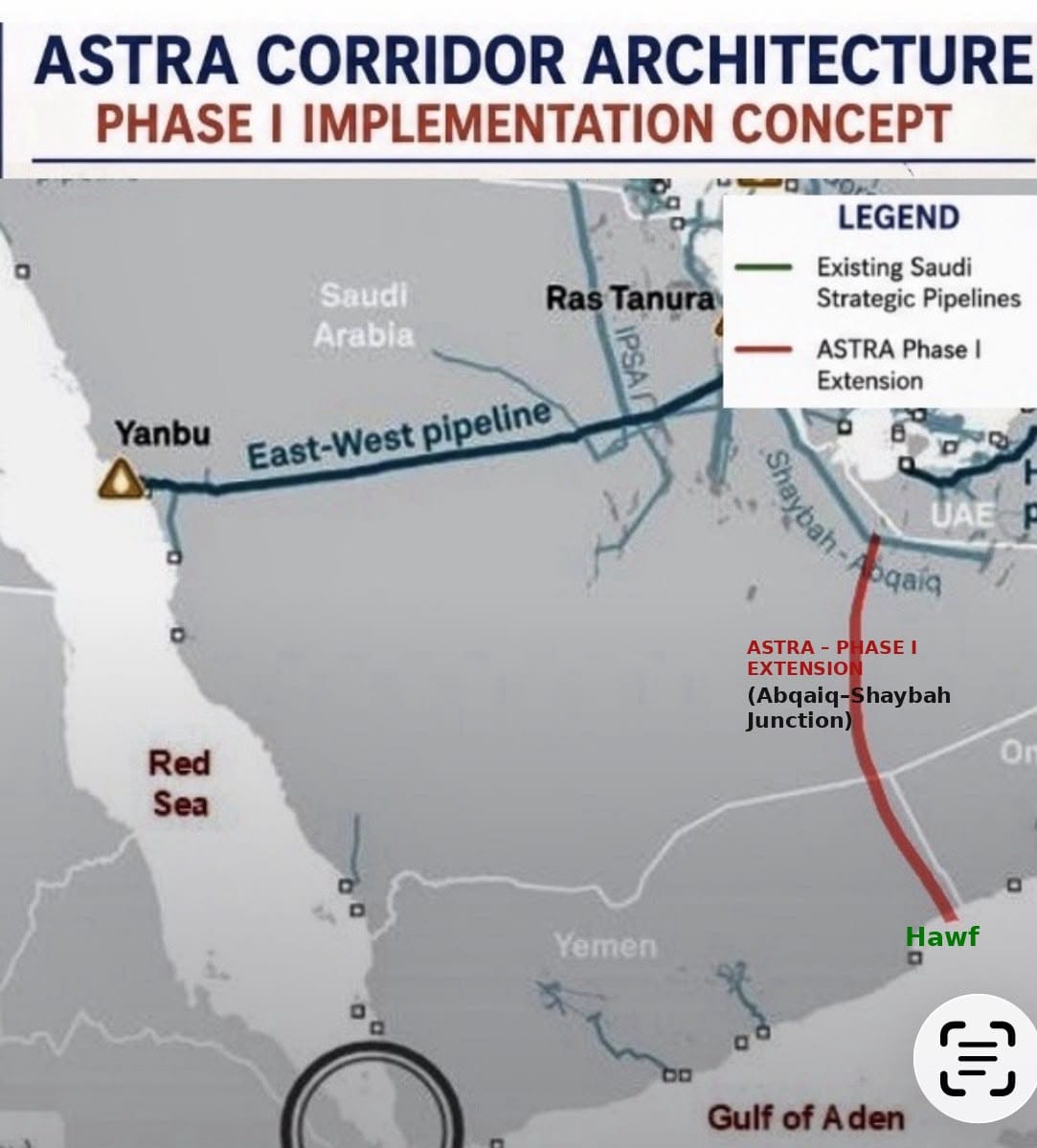
ASTRA begins as an architecture of strategic energy resilience. Its immediate purpose is to strengthen the security of Gulf hydrocarbon exports by reducing structural dependence upon vulnerable maritime chokepoints. History demonstrates that major strategic infrastructure often generates economic and geopolitical consequences extending well beyond its original purpose.
Over time, the infrastructure created to strengthen energy resilience could also provide the foundation for a broader system of strategic connectivity linking energy, logistics, trade and regional integration. That wider evolution should not be regarded as the immediate purpose of the concept, but as a longer-term strategic horizon illustrating how investments in resilience may generate wider economic and geopolitical dividends.
This distinction is important. The principal justification for ASTRA remains the strengthening of regional energy security. Nevertheless, by creating resilient transport infrastructure across the Arabian Peninsula, it could eventually facilitate deeper commercial integration, strengthen regional supply chains and encourage wider economic cooperation. Strategic redundancy therefore possesses the potential not only to reduce vulnerability but also to create new opportunities for regional development.
Recent developments suggest that the strategic debate surrounding Gulf energy security has entered a new phase. The central question is no longer simply how existing maritime chokepoints can be defended against disruption. It is how structural dependence upon those chokepoints can be progressively reduced before disruption occurs.
This shift carries important strategic and economic implications. Investments in strategic redundancy should no longer be judged solely by their construction costs, but by their capacity to reduce structural vulnerability, strengthen market confidence and preserve continuity during periods of geopolitical uncertainty. Strategic redundancy therefore represents not an additional burden upon an otherwise efficient system, but a long-term investment in resilience, stability and strategic flexibility.
ASTRA represents one practical application of that broader doctrine. More importantly, however, it reflects a wider transformation in strategic thinking—from protecting individual chokepoints towards redesigning the architecture of energy security itself. Deterrence will remain indispensable, but resilience can no longer depend upon deterrence alone. It requires strategic architecture capable of preserving continuity, expanding strategic choice and reducing the leverage created by excessive geographic concentration.
The strategic lesson emerging from recent developments is therefore clear. The future of Gulf energy security will depend less upon the perpetual defence of vulnerable maritime chokepoints than upon the gradual creation of strategic redundancy capable of delivering systemic resilience. In an era of interconnected maritime coercion, systemic resilience is becoming the organising principle upon which long-term energy security will increasingly depend.

Samsung’s CMA CGM claim highlights expanding carrier liability across increasingly integrated global logistics chains.

Bharat Container Shipping Line is part of a wider push into shipbuilding, container manufacturing and inland logistics.

Why an obscure law of naval warfare could reshape sanctions, shadow fleets and maritime ownership

New Delhi is trying to bring transhipment cargo back to Indian ports. Galathea Bay, Vizhinjam and a new national container line suggest India is also trying to gain greater influence over the infrastructure, vessels and networks through which that cargo moves.