
Beyond the Bypass: ASTRA and the Arabian Peninsula’s New Energy Architecture
ASTRA proposes resilient Arabian Sea energy corridors linking Saudi Arabia and Yemen, bypassing vulnerable chokepoints.
ASTRA proposes resilient Arabian Sea energy corridors linking Saudi Arabia and Yemen, bypassing vulnerable chokepoints.

Russian companies are repurposing Baltic and Arctic terminals to export grain traditionally shipped through the Black Sea. As attacks disrupt

From Churchill and Nuuk to Murmansk, Arkhangelsk and Kamchatka, a network of ports, railways and maritime gateways is beginning to reshape the geography of Arctic trade.
ASTRA proposes resilient Arabian Sea energy corridors linking Saudi Arabia and Yemen, bypassing vulnerable chokepoints.

The crisis in Gulf energy exports has produced workarounds for the workarounds. Oil escaping one threatened passage encounters another, while detours add weeks at sea and mounting costs. As Washington considers financing alternative corridors, ASTRA—the Arabian Sea Transit and Resilience Architecture—deserves assessment as a contribution to energy resilience and the shared prosperity that could help stabilise Yemen.
LinkedIn commentators Giacomo Prandelli and Gregory September illuminate different aspects of this predicament. Prandelli examines Saudi Arabia’s constrained export routes; September considers how emergency rerouting can increase Suez revenues while normal commerce remains impaired. Together, they show how keeping cargoes moving can coexist with declining confidence in the system.
Saudi Arabia’s East–West pipeline provides access to Yanbu without crossing Hormuz. Yet Asia-bound shipments leaving Yanbu still face Bab el-Mandeb. Avoiding that danger can require passage north through Suez or Egypt’s SUMED pipeline, then around Africa. Reuters documented Asian refiners’ consideration of this detour in July.
Additional tanker income may benefit Egypt, but those voyages consume more fuel, vessel capacity and working capital. Egypt’s lasting interest remains predictable Red Sea commerce. Meanwhile, the East–West pipeline’s reported restart at reduced capacity on 22 September, following an attack, demonstrates that alternative routes also depend on secure infrastructure ashore.
These vulnerabilities connect Hormuz and Bab el-Mandeb within one strategic risk system. Neither must close completely: selective interdiction and rising insurance costs can constrain exports while some vessels continue to pass. That is why Iran does not need to own both straits to gain from insecurity at both.
Against this background, the remarks of Jarrod Agen, US President Donald Trump’s energy adviser, carry particular significance. Speaking to The National on 23 September, Agen advocated multiple export corridors and alternatives beyond existing bypasses. His reasoning converges with the premise behind ASTRA, which I have been advocating: resilience depends on routes whose usefulness survives pressure elsewhere in the network.
The proposed Partnership for Allied Construction and Trust (PACT), reported this week, could give that thinking a financial framework. The Wall Street Journal reported a proposed $5 billion US contribution, seeking a matching $5 billion from Gulf and other Arab partners to establish an initial $10 billion fund. The Financial Times subsequently described ambitions for a broader investment platform exceeding $50 billion, drawing in sovereign and private capital. These figures represent proposed funding and intended scale, rather than secured pledges or committed capital.
The significance lies in the emerging willingness to finance resilience as a shared interest. Although no commitment to ASTRA is implied, the discussion creates an opportunity to ask which corridors deserve preparatory funding—and whether their selection will address the combined vulnerability of both straits.
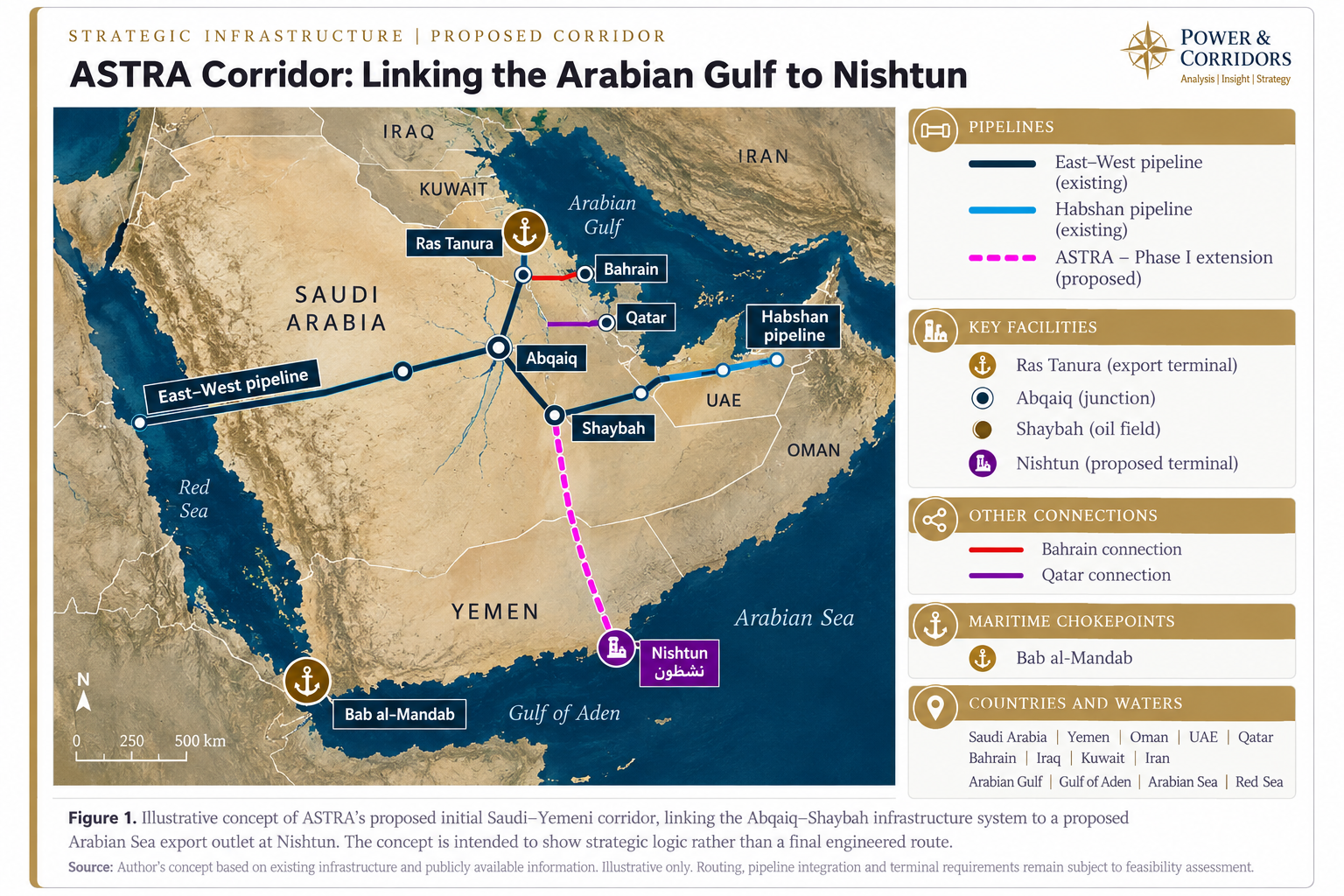
ASTRA offers a geographical response to that question. Its initial Saudi–Yemeni concept would examine a connection from the Abqaiq–Shaybah system through Al-Mahra to a proposed outlet at Nishtun, on eastern Yemen’s Arabian Sea coast. Cargoes departing towards Asia would begin their maritime journey beyond both straits, reducing the need to exchange one dangerous passage for another.
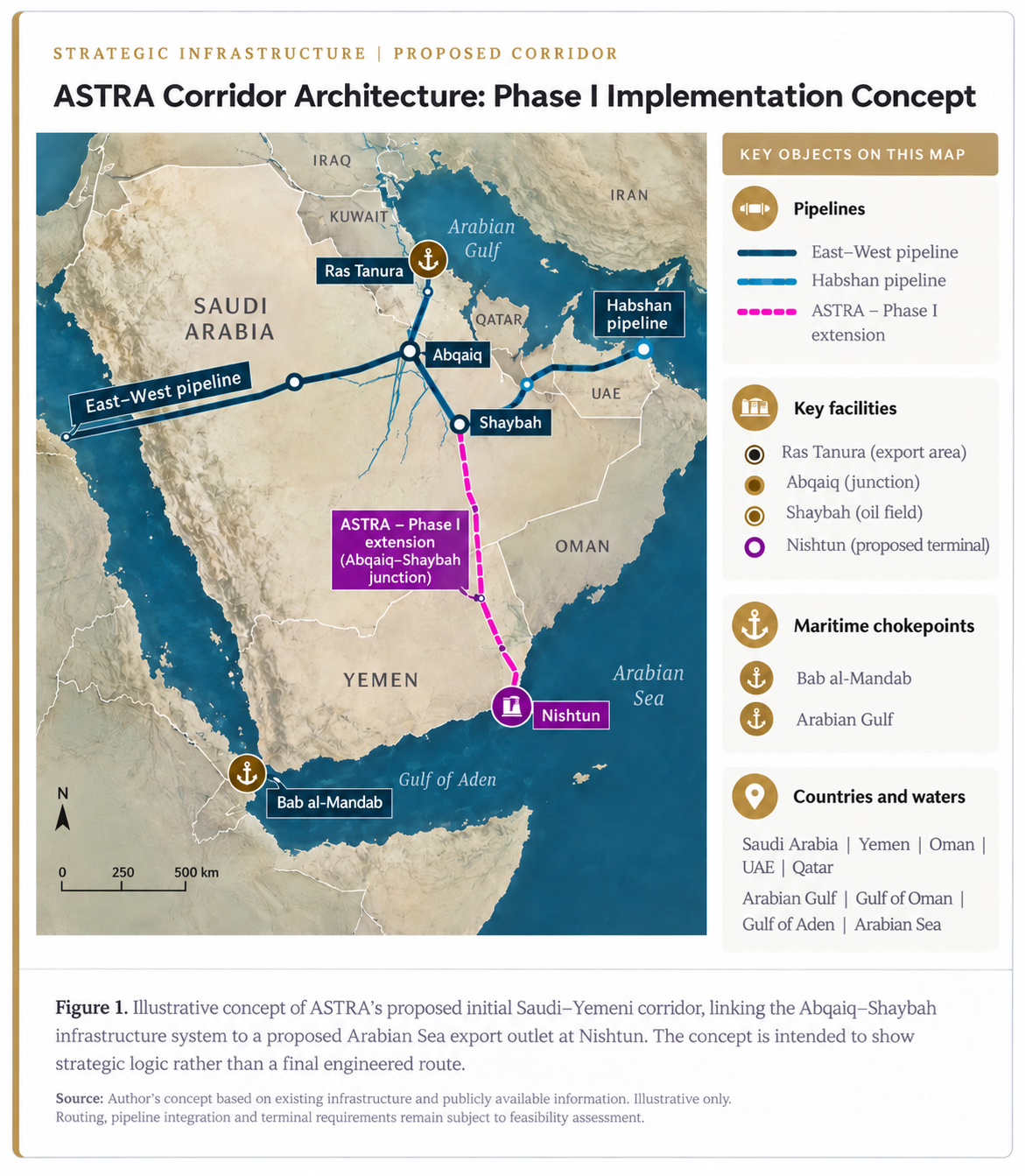
Existing infrastructure provides a starting point. Aramco documents the pipeline carrying Shaybah crude north to Abqaiq for processing. A southern connection requires assessment of flow configuration, treatment, pumping and capacity, alongside new cross-border infrastructure and export facilities. Engineering studies must establish how existing assets could reduce construction requirements.
The corridor would still face security risks and should be compared with options through Oman, expanded existing outlets and northern Mediterranean connections. Arabian Sea access has particular relevance for Asian customers, while northern corridors may better serve Europe. Their combined strength would lie in choices that remain usable under different disruptions.
That complementarity also changes the economic calculation. In my earlier Power & Corridors article, “From Strategic Redundancy to Systemic Resilience,” I argued that infrastructure costs must be weighed against recurrent disruption. A route with spare capacity in normal times may acquire considerable value when it prevents an interruption from spreading through export revenues, refinery operations and supply chains.
RELATED ANALYSIS
Examining how interconnected energy infrastructure, alternative export corridors and the economic costs of disruption are reshaping the foundations of energy security.
Read the full analysis →Appraisal should compare normal conditions with disruption at either strait, simultaneous pressure on both, and attacks on inland facilities. It should measure dependable export volumes, delivery times and avoided freight, insurance and inventory costs against construction, operating and protection expenses. Long-term demand uncertainty and the risk of underused capacity must also enter the calculation.
Shared dependencies also matter: routes relying on one vulnerable processing plant may offer less independence than their geography suggests. Benefits to importing economies must also be distinguished from revenues available to repay lenders, clarifying where public guarantees or shared investment may be justified.
Saudi Arabia and Yemen would be the initial partners, with Asian customers potentially contributing demand commitments. Wider Gulf participation would depend on viable connections, while gas requires dedicated infrastructure. As roads, communications, water and eventual rail links develop, ASTRA could help reintegrate Yemen into the economies of the Gulf and Arabian Peninsula. More reliable market access for producers, alongside Yemeni employment, services and transit revenues, would create complementary interests in the corridor’s success.
This shared economic interest also has political significance. Stability is a prerequisite for implementing and sustaining a project of this magnitude, yet preparatory work and consensus-building should begin early. Serious studies and dialogue backed by credible Yemeni, regional and international institutions could make the potential returns of cooperation visible, giving participants reasons to support a settlement, build institutions and invest in security.
Where economic hardship makes armed recruitment attractive, credible prospects for civilian livelihoods could begin to change the calculations that sustain conflict. Project discussions alone cannot deliver peace, but a believable development horizon could strengthen constituencies for compromise and reduce dependence on war-related income. In that sense, ASTRA could help shift expectations from enduring conflict towards sharing the gains of stability, making efforts to constrain Houthi coercion and advance a settlement more achievable.
That prospect depends on Yemen participating as a sovereign partner, with a state capable of securing the corridor and upholding citizens’ rights. Fair land arrangements, environmental safeguards, local employment and transparent revenues would give communities a tangible stake. Studies, agreements and guarantees would therefore help establish the project’s foundations while institutions develop the capacity to protect it.
This connects the eastern development agenda with the western security imperative examined in my 28 August Power & Corridors article. Restoring Yemeni state authority along the western coast would curb maritime coercion and support Bab el-Mandeb and Suez, through coordinated Yemeni, regional and international action. Eastward, ASTRA could deepen economic integration and shared interests. Stability would enable development, while credible development partnerships could help build and sustain stability.

A jointly sponsored Saudi–Yemeni pre-feasibility programme should now bring together operators, communities, customers and financing institutions. PACT’s eventual sponsors, if its rules permit, should consider supporting this work alongside other corridor studies. Moving from protecting chokepoints to building alternatives could then become part of a wider transition towards regional stability and shared prosperity.

From Churchill and Nuuk to Murmansk, Arkhangelsk and Kamchatka, a network of ports, railways and maritime gateways is beginning to reshape the geography of Arctic trade.

Samsung’s CMA CGM claim highlights expanding carrier liability across increasingly integrated global logistics chains.

Bharat Container Shipping Line is part of a wider push into shipbuilding, container manufacturing and inland logistics.

Why an obscure law of naval warfare could reshape sanctions, shadow fleets and maritime ownership