Canada’s Arctic Exercises Point to a Wider Contest Over Northern Corridors
Canada’s Arctic exercises highlight growing strategic competition as Russia and China expand Northern Sea Route activity.
Read ArticleCanada’s Arctic exercises highlight growing strategic competition as Russia and China expand Northern Sea Route activity.
Makkah links collective defence with trade corridors, infrastructure, industry and regional power.
Gulf states build transport alternatives to reduce dependence on the Strait of Hormuz.
Author
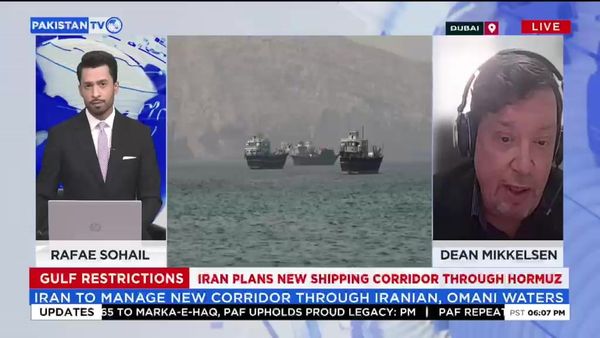
Dean Mikkelsen is Founder and Editorial Director of Power & Corridors. Based in Abu Dhabi, he focuses on geopolitical risk, maritime security, trade corridors, energy, logistics and critical infrastructure.
Analysis, commentary, reports and selected work by Dean Mikkelsen.
Canada’s Arctic exercises highlight growing strategic competition as Russia and China expand Northern Sea Route activity.
Makkah links collective defence with trade corridors, infrastructure, industry and regional power.
Gulf states build transport alternatives to reduce dependence on the Strait of Hormuz.
Tim Clark’s call for manufacturers to establish operations in Dubai reflects a broader UAE strategy to localise aircraft production, expand maintenance capacity and strengthen the aviation systems supporting trade, food security and economic growth.
From Barentsburg to Severomorsk, surveillance, submarines and undersea infrastructure are converging around one of the North Atlantic’s least understood strategic passages
MSC’s investment in next-generation freighters, foreign carriers’ reluctance to return to the Gulf and Emirates’ rapid expansion reveal how disruption is redrawing the global freight network.
The passage of Chinese-owned tankers through Bab el-Mandeb suggests that political identity, cargo declarations and direct clearance are becoming part of an informal maritime access system.
At 90, the Montreux Convention remains the legal architecture behind Türkiye’s maritime power—and a constraint on both Russia and NATO.
The US Navy spent years testing unmanned systems in Middle Eastern waters. The attack on Iran’s submarine facilities showed what that experimentation was preparing to deliver.
China’s scheduled Arctic service transforms seasonal access into a developing logistics network.
Corridor risk emerges through compliance, insurance and strategy before freight prices react.
Hormuz remains open, but control, revenue and authority are now contested.
IMEC’s future depends on resilient networks, not one vulnerable trade route.
Jones Act waivers expose America’s deeper maritime capacity and shipbuilding weakness.
China’s Arctic presence is shifting from scientific access to strategic influence.
Moscow may not need a war with NATO to test the alliance’s eastern flank.
Hormuz remains open, but routes, ownership and inbound traffic reveal growing pressure.
Russia’s shadow fleet keeps oil moving, but enforcement is raising hidden costs.
Middle Corridor gains importance as trade routes diversify across Central Asia, Caucasus and Europe.
Türkiye’s Blue Homeland doctrine turns maritime geography into strategic power projection.
Supply chains face sustained strain as corridor, tariff and insurance risks converge.
Canada must build strategic corridors, not simply surrender to US economic gravity.
As El Niño risk returns, Panama is trying to secure the canal’s future. But the fight over the Rio Indio reservoir shows that global trade resilience may come at a local human cost.
The US-Iran memorandum may ease immediate pressure, but renewed uncertainty around the Strait of Hormuz and Israel-Hezbollah exchanges shows that resilience, not normalisation, is now the central issue.