
Beyond the Bypass: ASTRA and the Arabian Peninsula’s New Energy Architecture
ASTRA proposes resilient Arabian Sea energy corridors linking Saudi Arabia and Yemen, bypassing vulnerable chokepoints.
ASTRA proposes resilient Arabian Sea energy corridors linking Saudi Arabia and Yemen, bypassing vulnerable chokepoints.

Russian companies are repurposing Baltic and Arctic terminals to export grain traditionally shipped through the Black Sea. As attacks disrupt

From Churchill and Nuuk to Murmansk, Arkhangelsk and Kamchatka, a network of ports, railways and maritime gateways is beginning to reshape the geography of Arctic trade.
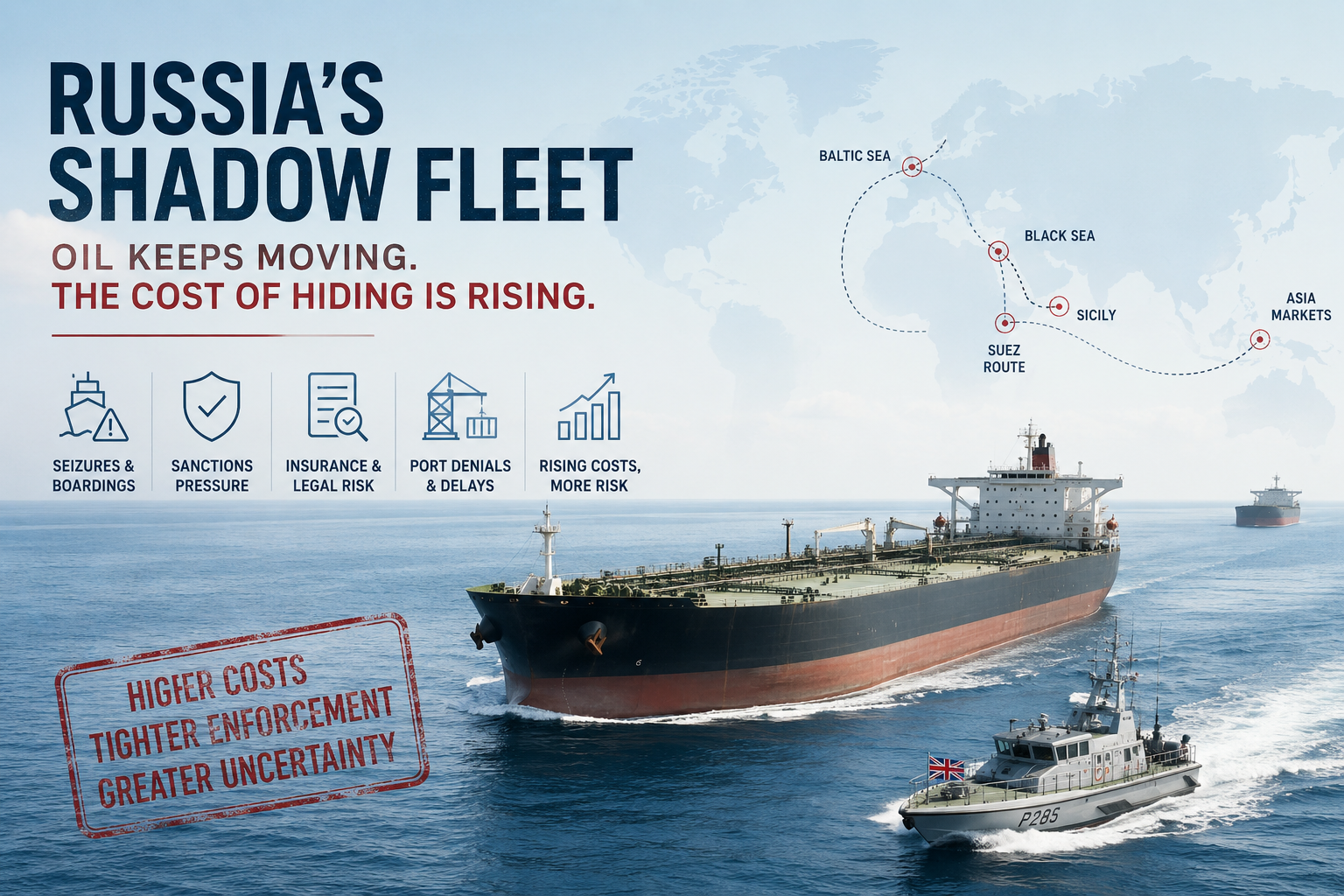
Russia’s shadow fleet keeps oil moving, but enforcement is raising hidden costs.

Russia’s shadow fleet has spent the past two years turning sanctions into a maritime shell game.
Older tankers, opaque ownership structures, shifting flags, unclear insurance and long voyages to buyers in Asia have allowed Moscow to keep oil moving despite Western restrictions. For much of that period, enforcement was largely a paperwork problem. Ships were sanctioned, companies were listed, insurers were warned and banks were told to tighten due diligence.
Now the story is starting to move from the legal page to the water.
In June, British forces boarded and seized the Smyrtos in the English Channel, in what the UK described as its first operation of this kind against a Russian shadow-fleet vessel. Days later, France seized the tanker Deliver near Sicily, after it had reportedly sailed from Russia’s Primorsk terminal toward the Suez Canal and Singapore.
The French case is especially important because it was not only about sanctions. Officials said the tanker was sailing under a Cameroonian flag despite having been removed from Cameroon’s registry, raising the question of whether it was effectively operating without nationality. That shifts the story from sanctions compliance into maritime law, flag validity and the ability of coastal and naval states to act against vessels that no longer fit cleanly inside the normal shipping system.
This is the real commercial issue. Russia’s shadow fleet is not being shut down. It is being made more complicated, more visible and potentially more expensive to operate.
The latest NERAI × Power & Corridors Shadow Fleet Enforcement Risk briefing points to this exact gap. Enforcement pressure is increasing, but the cost has not yet fully transmitted through the system. Russian fossil-fuel revenues remain substantial, and Reuters reported that Russia was set to export record crude volumes from its western ports in June, including Primorsk, Ust-Luga and Novorossiysk.
That is the contradiction at the centre of the shadow-fleet story. Europe is increasing pressure, but Russian oil is still moving.
The question is whether enforcement starts to change behaviour.
For shipowners, the risk is detention, delay and legal exposure. For charterers, it is demurrage, cargo uncertainty and route disruption. For insurers, it is whether cover is valid when a vessel’s ownership, flag or sanctions status is unclear. For banks and traders, it is the burden of proving that a cargo, vessel and counterparty are not exposed. For ports, it is whether allowing a vessel to call creates legal, environmental or reputational risk.
That is how enforcement becomes cost.
A single seizure does not stop the trade. But it changes the calculation for everyone around the trade. A tanker that may have passed quietly through a corridor last year may now attract naval attention, port scrutiny, insurance questions and banking delays. The shadow fleet can still function, but it becomes less frictionless.
The UK is also widening the pressure beyond individual ships. Its latest Russia sanctions package targeted more than 20 oil tankers and shipping-service providers linked to the shadow fleet. The EU is moving in the same direction. European Council conclusions in June called for a “whole of route” approach to undermine the shadow fleet’s business model, including coordination on the environmental, security and maritime-safety risks posed by these vessels.
That language matters. It means Europe is no longer looking only at the tanker itself. It is looking at the route, the flag, the insurer, the support companies, the port call, the cargo, the financing and the wider security risk.
The most exposed routes are the ones connecting Russian export terminals to global buyers. The Baltic and Black Sea remain central because they feed crude into international markets. The English Channel matters because it is a heavily monitored European transit point. The Mediterranean and Sicily matter because they sit on the route toward Suez and onward to Asian buyers. The Suez route matters because much of the trade still depends on long-haul movement to India, China and other markets outside the Western sanctions coalition.
This also creates a wider maritime-security problem. Shadow-fleet tankers are often older vessels operating under complex ownership and flag arrangements. If one is detained, disabled, uninsured or involved in an accident, the problem is not only a sanctions issue. It becomes an environmental, legal and port-state problem. The Atlantic Council has warned that the shadow fleet is increasingly undermining the maritime order, with more inspections and detentions taking place in 2026 and Russian military vessels beginning to escort some ships through sensitive waters.
For Russia, the system still works as long as oil keeps moving and buyers remain available. But the model depends on low-friction transit. If vessels face more inspections, if flags are challenged, if insurers step back, if ports refuse entry, or if cargoes become harder to finance, the shadow fleet becomes more expensive to run.
That does not mean Russian exports collapse overnight. The more likely outcome is a slow rise in hidden costs: higher freight, longer voyages, more legal checks, more opaque intermediaries, higher insurance risk and greater delays around sensitive corridors.
For companies exposed to shipping, commodities, insurance, trade finance or port operations, this is the point to watch. The shadow fleet is not disappearing. But the environment around it is changing.
The next phase will be defined by whether recent European seizures remain isolated events or become part of a more systematic enforcement campaign. If they remain occasional, Russia can absorb the disruption. If they become routine, the shadow fleet’s advantage begins to erode.
The story is no longer simply that Russia has found a way around sanctions.
The story is that the route around sanctions is becoming more visible, more contested and more expensive.

Hormuz disruption drives energy rerouting, higher premiums, strategic diversification and broader geopolitical adaptation worldwide.

Regionalised conflict increasingly reshapes Gulf security, European hybrid risks, diplomacy, energy and commercial behaviour patterns.

Conflict across Hormuz and Red Sea is reshaping global energy security priorities.

Dean Mikkelsen joins Pakistan TV Global's Perspective to discuss the economic and strategic costs of the U.S.–Iran war, disruption in the Strait of Hormuz, military readiness, sanctions and prospects for diplomacy.