

Commercial Disruption Alert - 10 Sept 2026 - East Asian Ports
Repeated typhoons disrupt East Asian ports, delaying vessels and weakening schedule reliability.
Repeated typhoons disrupt East Asian ports, delaying vessels and weakening schedule reliability.

Mundra strike ends, but container backlogs and logistics disruption may persist temporarily.
Dover protest blockades expose freight vulnerability across critical UK Channel port access
Hormuz remains open, but control, revenue and authority are now contested.

The Strait of Hormuz is not closed. That is no longer the most important point.
The deeper question is who gets to decide what “open” now means. Is the strait open because international law protects transit through one of the world’s most important maritime chokepoints? Is it open because Iran chooses not to close it? Is it open because Oman and Iran can manage separate routes through adjacent waters? Or is it open because the United States now claims the role of external guarantor, security provider and potential toll collector?
That is where the crisis has moved. The dispute is no longer only about tanker attacks, ceasefire violations or whether oil and LNG can move through Hormuz tomorrow morning. It is becoming a contest over authority, revenue and control.
Donald Trump’s brief proposal to make the United States the “Guardian of the Hormuz Strait” and charge a 20 percent fee on cargo moving through the waterway appeared to transform that contest into an explicit claim over paid security. His reversal a day later, replacing the proposed charge with trade and investment deals with Gulf states, did not end the dispute. It clarified it.
The toll may have been dropped. The idea that Hormuz security can be monetised has not disappeared.
That is the important shift. Trump stepped back from the most disruptive version of the proposal, but he did not return to the old language of neutral freedom of navigation. He maintained that the strait would remain open to all shipping except vessels linked to Iranian ports or Iranian cargo, while preserving the broader claim that Washington can define what open passage means.
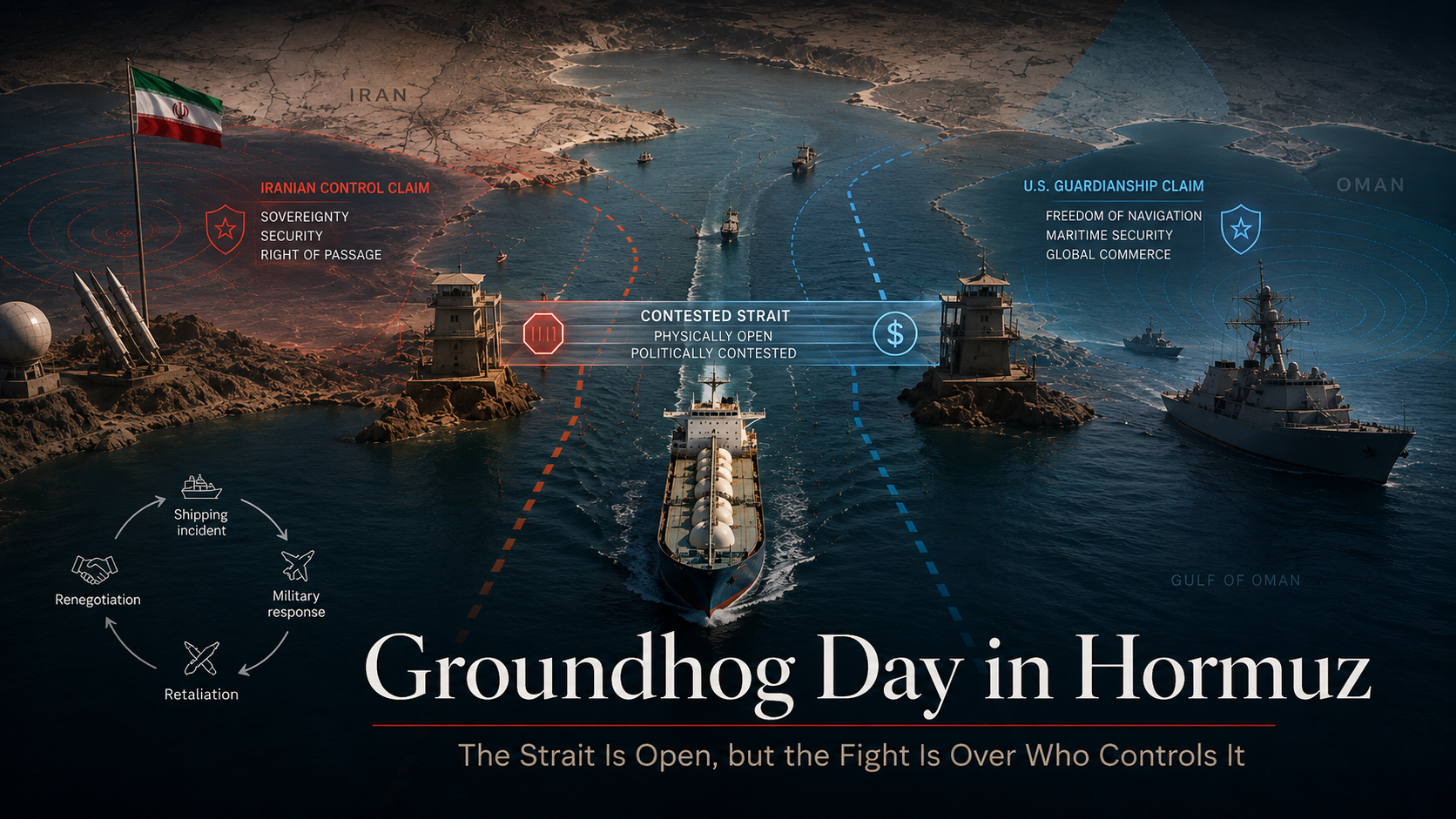
This is why the latest escalation feels like Groundhog Day. The same sequence keeps returning with only slight variations: maritime pressure near Hormuz, a US military response, Iranian retaliation against US-linked positions in the Gulf, Trump declaring the existing arrangement broken or inadequate, and then the possibility of another renegotiation.
The pattern is now clear. Iran uses operational pressure around Hormuz to create leverage. Trump uses rhetorical rupture to create leverage. Both approaches converge around the same narrow waterway.
Trump’s 20 percent proposal lasted barely a day, but it mattered because it exposed the direction of the argument.
For decades, the strategic fear around Hormuz was closure. Closure would be dramatic, visible and globally destabilising. But it would also be risky for Iran. It could trigger a major US-led response, alienate energy-importing states and damage Iran’s own remaining economic channels.
A contested open strait is more useful. It allows pressure to be applied without the full consequences of formal closure. It allows Iran to raise the cost of ignoring its role. It allows Washington to say it is keeping the strait open while demanding compensation from regional partners or commercial users.
Trump’s move briefly made that logic explicit. The United States would provide security. The world would pay. Then, when the legal and commercial implications became clear, the charge was replaced with investment deals. That reversal reduces the immediate shock for shipping, but it does not remove the larger issue.
The International Maritime Organization’s opposition to fees for passage through international straits underlined the legal problem. A mandatory toll through Hormuz would have set a precedent that could weaken the very freedom-of-navigation principle Washington has spent years defending. It would also have echoed the Iranian argument that security, routing and passage through the strait can be tied to payment.
That is why the reversal is not simply a climbdown. It is also a warning. The language of tolls has entered the Hormuz crisis. Even if the US fee disappears, the idea that ships will pay for Hormuz security may return in another form.
The June MoU was never peace. It was a temporary pause in full hostilities and a framework intended to create space for negotiation. It reduced one form of crisis while leaving the hardest issue unresolved: who controls the conditions under which Hormuz remains open.
The agreement created space for a 60-day process, including the restoration of toll-free navigation through the Strait of Hormuz, but it did not settle the future management of the strait, the role of Iran and Oman in routing, the status of shipping fees or service charges, the limits of US naval action, or the legal position of Gulf states whose energy security depends on predictable passage.
The problem was built into the structure of the pause. A ceasefire can survive limited violations if the parties continue to treat it as the main reference point for de-escalation. But when the same pressure points return again and again, the agreement begins to lose its restraining function even if it remains alive on paper.
That is what appears to have happened. The MoU did not collapse in a single moment. It was hollowed out by repetition.
Iran’s actions since the MoU have not been random. They have combined negotiation, route pressure and selective coercion.
The clearest explanation comes from the emerging dispute over Hormuz governance. Iran has not simply threatened to close the strait. It has sought to shape the rules of passage through it. The issue is not only whether vessels can transit; it is whether they do so under Iranian expectations, Iranian coordination and potentially Iranian fees.
The post-MoU shipping incidents around the Oman approaches and Hormuz corridor are therefore more than tactical attacks. They are signals about control. Vessels using routes that do not align with Iranian expectations have become part of the pressure campaign. Iran’s message is that commercial shipping cannot treat Hormuz as a neutral space if Tehran believes its own role is being bypassed.

This is why the route question matters. The dispute over northern and southern transit options, Iranian waters, Omani waters and the role of Musandam is not a technical detail. It is the geography through which political authority is being tested. A mechanism that appears on paper to create safe passage can become, in practice, a contest over who sets the rules.
Iran’s attempt to combine diplomacy and coercion shows that Tehran is trying to convert wartime leverage into a longer-term role over Hormuz. Iranian interest in a mechanism with Oman that could include service charges on vessels moving through the strait is not a side issue. It goes to the heart of the crisis.
Iran does not need to close Hormuz to benefit from Hormuz. It needs the world to accept that safe, predictable passage requires Iranian consent.
Trump’s pattern is different, but it converges with Iran’s at the same point.
He repeatedly treats agreements as temporary leverage platforms rather than settled frameworks. An understanding can be announced, tested, criticised, declared inadequate, declared broken and then reopened from a harder position. That does not mean diplomacy is dead. It means diplomacy is being conducted through rupture language.
His declaration that the ceasefire was “over” should be read in that light. It weakened the political utility of the agreement, but it did not automatically close the diplomatic channel. It was part of a familiar renegotiation cycle: declare the existing terms unacceptable, raise pressure, force the other side to respond and then reopen talks from a stronger position.
The same pattern was visible in the toll episode. First came the maximal claim: the United States as guardian of Hormuz, reimbursed through a 20 percent cargo fee. Then came the retreat: the fee would be replaced by Gulf trade and investment deals. The reversal may lower the immediate commercial shock, but it does not restore predictability.
It instead reinforces the central problem. Washington is now moving between military enforcement, financial demands, legal ambiguity and investment bargaining. For shipping, energy markets and Gulf states, that creates a policy risk alongside the security risk.
The practical mechanism remains unclear. There is no detailed public framework showing how Gulf investment commitments would substitute for a cargo fee, how the US blockade of Iran-linked shipping will be enforced, or how neutral vessels will be treated if they are suspected of carrying Iranian cargo. Maritime-sector reporting has also noted that no supporting legal or operational guidance has been released to explain how the proposed arrangements would work in practice.
The political message, however, is clear. Washington is no longer only promising freedom of navigation. It is asserting a power to define the cost, conditions and enforcement structure of passage.

That is the mirror image of Iran’s position. Iran says it is the indispensable power in Hormuz because of geography, sovereignty and coercive proximity. Trump is saying the United States is the indispensable power because it can keep the strait open by force, and either charge directly or extract compensation indirectly.
The fight is no longer only about whether Hormuz is open. It is about who gets to define openness.
The latest weekend attacks did not create a new pattern. They extended an existing one.
Commercial vessels were hit or threatened near Hormuz and the Oman approaches. The United States responded with strikes against Iranian maritime and military infrastructure. Iran retaliated against US-linked positions in Kuwait and Bahrain. Trump then escalated rhetorically and introduced a new control claim over the strait.
The shipping side of the pattern was already visible before the latest Trump statement. The threat risk for Hormuz transits had been raised to severe after tankers were damaged near the strait, while ship-tracking and maritime-security updates pointed to reduced confidence around the route. Iran’s own messaging warned vessels against uncoordinated movement and behaviour that Tehran framed as undermining safe passage.
The military side followed quickly. US strikes targeted Iranian naval and maritime infrastructure, including facilities linked to Iran’s ability to threaten commercial shipping. The purpose was to degrade Iran’s capacity to continue attacks on maritime traffic and impose costs for the latest round of escalation.
Then came the regional retaliation pattern. Iran’s attacks on US-linked sites in Kuwait and Bahrain were not random. Both states host critical US-linked military infrastructure and sit within Iran’s preferred retaliation geography. Hitting or threatening those locations allows Tehran to answer US action without immediately moving to direct, unlimited war.
This is why the same places keep appearing. Hormuz is the maritime pressure point. Kuwait and Bahrain are the military pressure points. Oman is the corridor and mediation pressure point. Qatar is the financial and LNG pressure point. The UAE is exposed through ports, routing and proximity. The pattern is regional, but it keeps returning to the same core geography.
Qatar’s role deserves attention precisely because it was not the obvious target in the latest round.
Qatar matters to Iran in several ways. It is central to LNG flows through Hormuz. It is an important diplomatic channel. It is also linked to the frozen-funds track, where Iranian access to money has been one of the recurring issues in the wider negotiation. If Washington is unwilling to release funds on Tehran’s preferred terms, Iran has to find leverage elsewhere.
That elsewhere is Hormuz.
The frozen-funds issue has repeatedly been tied to the question of safe passage. Iranian sources have linked the release of frozen assets held in Qatar to ensuring safe passage through the Strait of Hormuz. Later discussions over billions of dollars in Iranian assets again placed the financial track close to the maritime-security track.
This creates a powerful incentive. Sanctions relief is uncertain. Direct access to frozen funds is contested. A major war would risk further degradation of Iranian military capability. What remains is the ability to make predictability expensive for everyone else.

That can happen through attacks, but it can also happen without constant attacks. Delays, war-risk premiums, route uncertainty, insurance costs, possible service charges, AIS concerns and the fear of selective disruption all create value for Iran as bargaining tools. Tehran may not be able to compel payment directly in every case, but it can raise the cost of ignoring its claims.
This is why the service-charge issue, Trump’s withdrawn cargo fee and the replacement investment-deal language belong in the same article. They are not identical legally or politically, but they reveal the same transformation. Hormuz is becoming a contested revenue space as well as a contested security space.
The old question was whether Iran would close the Strait of Hormuz. The new question is whether Hormuz can remain open without becoming a tollbooth.
Iran’s position implies that passage should reflect Iranian authority. Trump’s position implies that passage should reflect US protection. The fee reversal changes the method, but not the underlying logic. Both sides keep the strait nominally open. Both turn openness into something conditional.
This is a major shift. A contested open strait is more useful than a formally closed strait. It allows Iran to avoid the full costs of closure while still extracting leverage from uncertainty. It also allows Trump to avoid saying the strait is closed while presenting the United States as the power that keeps it open.
That is why the phrase “open” has become slippery. The strait can be open in a physical sense and unstable in a commercial sense. It can be open to ships but closed to predictability. It can be open under international law while contested by states that want to manage, police or price access.
The most important consequence of Trump’s 20 percent proposal may be that it normalised the language of payment. Even after the formal fee was withdrawn, the idea that Hormuz security has a price remained on the table.
That is the danger. By linking Hormuz security to payment, even briefly, Trump blurred the line between freedom of navigation and paid access. Iran does not need to copy the US proposal directly. It only needs the precedent that security, passage and payment can be discussed in the same sentence.
The toll may not be called a toll next time. It may be called a service charge, a security contribution, an investment package, an escort arrangement, an insurance premium or a routing compliance cost. But for commercial users, the outcome may be similar: Hormuz remains open, but every transit carries a political surcharge.
The Iranian response to Trump’s guardian language was predictable. Iran does not want a foreign security authority in the strait, and it certainly does not want the United States to define itself as the paid guarantor of Hormuz.
The core message from Tehran’s information space is consistent with Iran’s wider position: Hormuz security is determined by Iran’s will, not by Trump’s statements or the presence of US warships. Specific claims circulating online should be treated carefully unless confirmed through primary Iranian outlets, but the political logic is not difficult to read.
Iran is not saying merely that it can attack. It is saying that no outside power can define the strait without Iran.
This is what makes the latest moment so dangerous. Both sides are now asserting a claim to guardianship. Iran claims the right to manage Hormuz from geography. Trump claims the right to manage Hormuz from military enforcement. Gulf states and maritime powers are left with the consequences.
The argument is no longer confined to naval escorts or missile strikes. It has become a dispute over legitimacy. Who has the right to guarantee passage? Who has the right to charge? Who has the right to define non-compliance? Who has the right to punish it?
Those questions cannot be solved by one more strike package.
The danger is not necessarily a slide into full regional war. None of the principal actors appears to benefit from that outcome. The more likely danger is a prolonged cycle of calibrated retaliation in which each side believes one more strike, one more warning, one more fee proposal, one more reversal or one more renegotiation will improve its position.
That creates a condition somewhere between war and peace.
The United States can strike Iranian maritime infrastructure, but that does not eliminate Iran’s asymmetric options. Iran can retaliate against US-linked sites in the Gulf, but that does not force an American withdrawal. Gulf states can condemn escalation, but they cannot move their geography. Shipowners can delay, reroute or demand premiums, but they cannot wish away the strait.
The result is sustained uncertainty. The strait remains open, but the cost of using it rises. Energy markets continue functioning, but the risk premium grows. Diplomacy continues, but the MoU loses its ability to restrain behaviour.
That is why the crisis should not be measured only by oil prices or by whether a formal closure has been declared. The more important indicators are tanker availability, war-risk insurance, demurrage, LNG scheduling, port delays, naval posture and whether commercial actors begin behaving as if the strait is only conditionally reliable.
Even without a formal toll, ships may still pay a de facto one through insurance, charter rates, delays and risk management. That is the commercial version of the same political problem.
The MoU keeps failing because it did not answer the question that now dominates the crisis.
Who controls Hormuz?
Not in the abstract. Not in a textbook sense. In practical terms: who approves routes, who provides security, who charges fees, who defines hostile or non-compliant shipping, who controls the risk environment and who receives recognition for keeping the strait open?
Every cycle returns to that question.
First, an understanding creates temporary calm. Then Iran tests the grey zone. The United States responds. Iran retaliates regionally. Trump declares the framework broken or inadequate. A new negotiation begins from a more dangerous position. The next round then repeats the same unresolved contest.
That is the Groundhog Day dynamic. It is not simple repetition. It is repetition with escalation.
Each cycle leaves behind new facts: more damaged vessels, more US strikes, more air-defence activations in Kuwait and Bahrain, more pressure on Oman, more exposed LNG flows from Qatar, more uncertainty for insurers and a more explicit contest over revenue.
The MoU may survive as a diplomatic reference point, but it is failing as a behaviour-control mechanism.
The Strait of Hormuz may remain open. But openness is no longer the same as stability.
Iran wants managed openness under Iranian influence. Trump wants managed openness under US protection, with compensation now shifted from a direct cargo charge to Gulf investment commitments. Gulf states want predictable openness without institutionalising Iranian leverage or paying new costs to Washington. Shipowners want clarity, not competing claims. Energy buyers want cargoes to move without turning every transit into a political event.
Those goals do not align.
That is why another renegotiation may not end the crisis. It may simply restart the same cycle under new wording. Unless the next framework deals directly with control, routes, fees, security authority and the role of Oman, the UAE, Qatar, Kuwait and Bahrain, it will leave the same structural problem in place.
The strait is open. But the fight is now over the meaning of open.
That is the central shift. Hormuz is no longer just a place where conflict might interrupt trade. It is becoming the mechanism through which conflict, diplomacy, revenue and authority are being negotiated.
The crisis will not end when someone says the strait is open. It will only begin to ease when the actors agree who has the right to keep it that way and on what terms.

Samsung’s CMA CGM claim highlights expanding carrier liability across increasingly integrated global logistics chains.

Bharat Container Shipping Line is part of a wider push into shipbuilding, container manufacturing and inland logistics.

Why an obscure law of naval warfare could reshape sanctions, shadow fleets and maritime ownership

New Delhi is trying to bring transhipment cargo back to Indian ports. Galathea Bay, Vizhinjam and a new national container line suggest India is also trying to gain greater influence over the infrastructure, vessels and networks through which that cargo moves.