

Commercial Disruption Alert - 10 Sept 2026 - East Asian Ports
Repeated typhoons disrupt East Asian ports, delaying vessels and weakening schedule reliability.
Repeated typhoons disrupt East Asian ports, delaying vessels and weakening schedule reliability.

Mundra strike ends, but container backlogs and logistics disruption may persist temporarily.
Dover protest blockades expose freight vulnerability across critical UK Channel port access
ASTRA offers strategic redundancy beyond Hormuz and Bab el-Mandeb through Arabian Sea connectivity.


For decades, the Strait of Hormuz has occupied a unique place in global geopolitics. Connecting the Arabian Gulf to the Gulf of Oman and the Indian Ocean, the narrow waterway carries roughly one-fifth of globally traded oil and a substantial share of liquefied natural gas, making it one of the world's most consequential maritime chokepoints.
In his recent essay for Power & Corridors, Kristian Alexander described what may be termed the “Hormuz paradox”: the very leverage created by dependence on the Strait simultaneously encourages states and markets to reduce that dependence. The more frequently a chokepoint is used—or threatened—as an instrument of coercion, the stronger the incentive becomes to develop alternative routes that gradually erode its strategic value.
Related Analysis
Kristian Alexander examines how strategic leverage around Hormuz encourages the development of alternative routes.
Read the full analysis →Recent developments in the Gulf and Red Sea suggest that this paradox is no longer merely theoretical. They also indicate that maritime chokepoints can no longer be assessed in isolation, as pressure on Hormuz increasingly shapes calculations surrounding Bab el-Mandeb and other connected gateways.
The question, therefore, is not whether Hormuz should continue to be protected. It undoubtedly must. The more consequential question is whether the international economy should remain as dependent upon it as it is today.
For decades, the principal response to risks surrounding Hormuz has been deterrence. Regional and international actors have invested immense resources in naval deployments, surveillance capabilities and security partnerships intended to preserve freedom of navigation.
These measures remain indispensable, but they cannot eliminate the structural vulnerability created by overdependence.
A chokepoint need not be comprehensively sealed to exert strategic leverage. The possibility of attack may be sufficient to cause shipowners to delay voyages, insurers to revise risk assessments and energy traders to price disruption into global markets. Recent reports of vessels declining even military-guided transits through Hormuz illustrate how commercial behaviour may change before a route becomes physically impassable.
The central problem is therefore not simply whether the Strait can be closed. It is how much economic disruption can be generated by uncertainty surrounding its continued accessibility.
Deterrence may reduce the probability of physical interdiction. It does not remove the costs of dependence.
The prospect of simultaneous pressure on Hormuz and Bab el-Mandeb is becoming increasingly credible.
For many years, analysis of the two waterways proceeded largely along separate tracks. Hormuz was treated as the principal gateway for Gulf hydrocarbons, while Bab el-Mandeb was viewed primarily through the security of the Red Sea, the Suez Canal and trade between Asia and Europe. Recent developments reveal how closely their strategic significance can become intertwined.
A Reuters analysis published on 14 July argued that, after exerting pressure around Hormuz, Iran could increasingly regard the Red Sea gateway as an additional source of leverage through its relationship with the Houthis, moving the Hormuz–Bab el-Mandeb linkage from specialist analysis into mainstream strategic discussion.
Two days later, Reuters reported a more serious development: according to three sources, Tehran had asked the Houthis to stand ready to close the Bab el-Mandeb route if the United States struck Iranian power infrastructure and had positioned missiles and drones for possible action against shipping.
The distinction is significant: the first identified Bab el-Mandeb as a potential second pressure point; the second described reported preparations for an operational contingency.
Whether such an order is ultimately implemented remains uncertain. Its significance lies in the fact that simultaneous disruption of the Middle East's two principal energy gateways is now being considered not merely as an analytical possibility, but as a plausible escalation scenario.
Commercial responses already demonstrate that comprehensive closure is unnecessary to produce leverage. Rerouting, delayed sailings, higher insurance costs and changes in export patterns can impose economic consequences well before maritime traffic is halted altogether.
Modern infrastructure systems are rarely designed around a single point of failure. Electricity grids, telecommunications networks and digital platforms incorporate backup capacity precisely because efficiency without redundancy can produce fragility.
Strategic geography should increasingly be approached in the same way.
The objective is not to replace existing sea lanes or diminish the importance of Hormuz. It is to complement them with additional pathways capable of absorbing part of the pressure when established routes are threatened.
Gulf states have already embraced elements of this logic. Saudi Arabia can move oil through its East–West Pipeline to the Red Sea, while Oman exports directly from terminals situated outside Hormuz. A Reuters poll published on 16 July found that Saudi Arabia and Oman were the only Gulf Cooperation Council economies still expected to expand during the current disruption, while more heavily exposed economies faced contraction. This suggests that alternative export infrastructure can translate into measurable economic resilience.
Yet existing alternatives do not solve the entire problem. Saudi exports reaching the Red Sea may bypass Hormuz, but shipments bound for Asian markets can still face exposure at Bab el-Mandeb. Vulnerability is therefore reduced at one gateway only to reappear at another.
The challenge is no longer simply to bypass one chokepoint. It is to build options that reduce dependence across several linked passages.
This is where the Arabian Sea coastline of eastern Yemen acquires particular strategic importance.
Unlike outlets terminating at Fujairah or elsewhere in the Gulf of Oman, an eastern Yemeni corridor would reach the open Arabian Sea beyond the immediate geographical setting of the Strait of Hormuz. It could also provide direct access to the Indian Ocean without requiring eastbound energy flows to traverse Bab el-Mandeb.
Such an outlet would not replace existing infrastructure or be used continuously by every producer. Its value would lie in providing additional capacity and optionality during disruption.
Security in an era of linked maritime vulnerabilities cannot rest solely on defending individual passages. It increasingly requires diversified geographies capable of reducing the consequences of pressure on several gateways at once.
This is the strategic logic underlying the Arabian Sea Transit, Resilience and Access Corridor Architecture, or ASTRA.
ASTRA envisages the gradual development of a regional energy, transport and connectivity architecture extending towards the Arabian Sea coastline of eastern Yemen. Its principal objective would not be to replace existing pipelines, ports or maritime routes, but to provide additional strategic outlets and greater redundancy by reducing overdependence on vulnerable chokepoints.
An Arabian Sea outlet could offer particular value because it would sit beyond the immediate geographical constraints of the Strait of Hormuz. For eastbound trade and energy flows, it could also provide access to the Indian Ocean without requiring vessels to pass through Bab el-Mandeb.
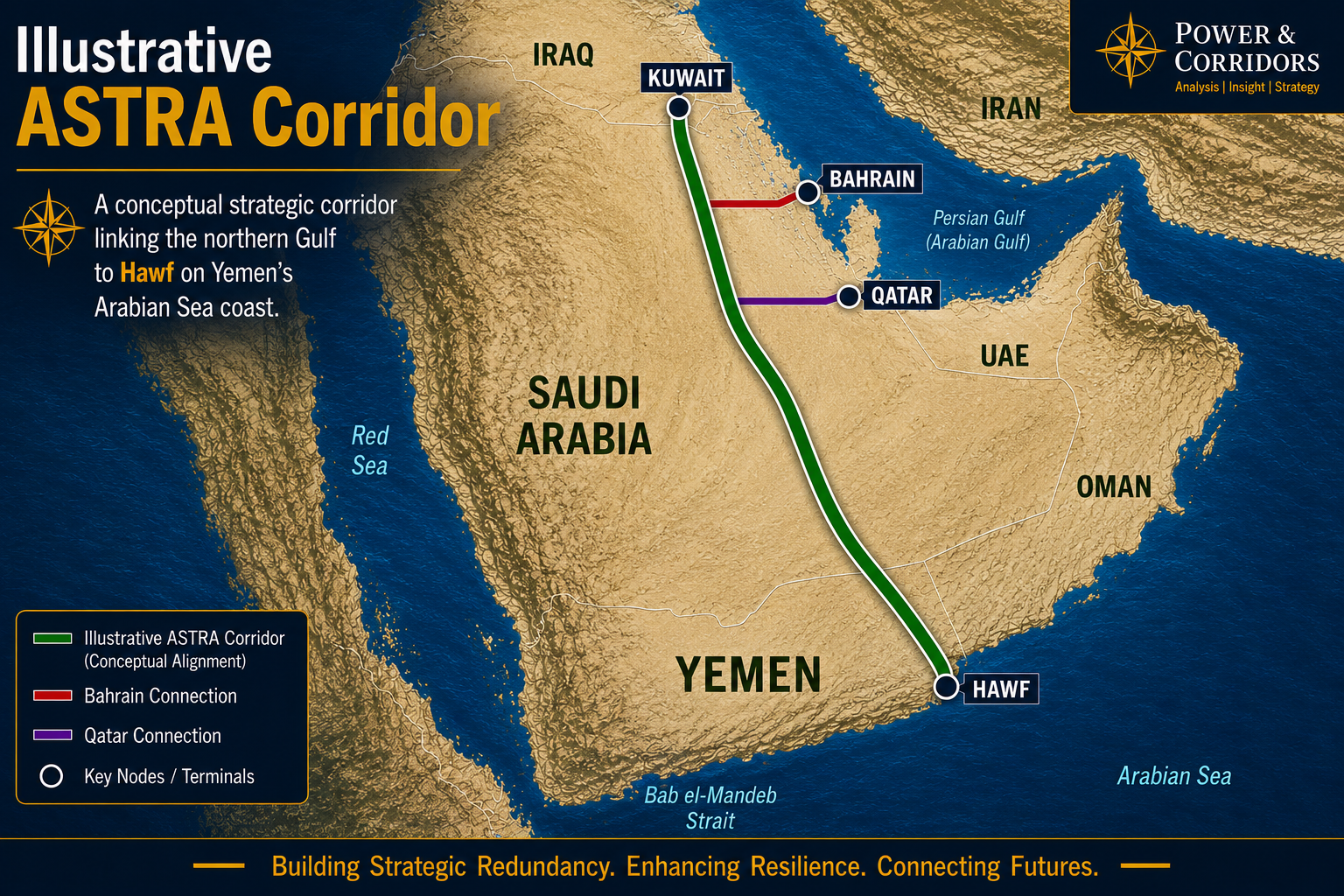
Over time, the architecture could support supplementary pathways for hydrocarbons, goods and infrastructure connections originating across parts of the Arabian Peninsula. Depending on technical feasibility, commercial demand and political agreement, this could include flows associated with Iraq, Kuwait, Saudi Arabia, Qatar and the United Arab Emirates.
The concept is not that all regional production would be channelled through a single pipeline or that existing export terminals would become redundant. ASTRA is better understood as a layered corridor architecture incorporating energy infrastructure, transport links, logistics facilities, ports and potentially digital connectivity, developed progressively rather than as one fixed megaproject.
Its strategic value would lie in optionality. Participating states would gain access to an additional outlet during periods of disruption, while eastern Yemen could become more closely integrated with Gulf economies and the wider Indian Ocean trading system.
ASTRA would therefore serve three related purposes: facilitating transit, strengthening resilience and expanding access. It would reduce exposure to single points of failure, improve crisis flexibility and create a longer-term framework for economic integration.
Recent events give this concept greater urgency. As pressure on Hormuz increasingly interacts with insecurity around Bab el-Mandeb, strategic redundancy can no longer be treated as an abstract aspiration. It must become a central principle of regional infrastructure planning.
Geography remains a powerful source of opportunity and constraint. But infrastructure can alter the consequences of geography by changing where energy, goods and data move—and by reducing the leverage attached to any single route.
The broader lesson is becoming clear: maritime security cannot depend indefinitely on protecting the same vulnerable passages while leaving the underlying concentration of risk unchanged.
The future belongs not only to those who defend chokepoints, but also to those who build credible alternatives to them.
In an increasingly uncertain world, redundancy is not inefficiency.
It is strategy.

Samsung’s CMA CGM claim highlights expanding carrier liability across increasingly integrated global logistics chains.

Bharat Container Shipping Line is part of a wider push into shipbuilding, container manufacturing and inland logistics.

Why an obscure law of naval warfare could reshape sanctions, shadow fleets and maritime ownership

New Delhi is trying to bring transhipment cargo back to Indian ports. Galathea Bay, Vizhinjam and a new national container line suggest India is also trying to gain greater influence over the infrastructure, vessels and networks through which that cargo moves.