

Beyond the Bypass: ASTRA and the Arabian Peninsula’s New Energy Architecture
ASTRA proposes resilient Arabian Sea energy corridors linking Saudi Arabia and Yemen, bypassing vulnerable chokepoints.
ASTRA proposes resilient Arabian Sea energy corridors linking Saudi Arabia and Yemen, bypassing vulnerable chokepoints.

Russian companies are repurposing Baltic and Arctic terminals to export grain traditionally shipped through the Black Sea. As attacks disrupt

From Churchill and Nuuk to Murmansk, Arkhangelsk and Kamchatka, a network of ports, railways and maritime gateways is beginning to reshape the geography of Arctic trade.
A Russian research vessel was not seized for sanctions violations. Its detention in Svalbard points to a different maritime risk: ships becoming recoverable assets in the enforcement of international judgments.

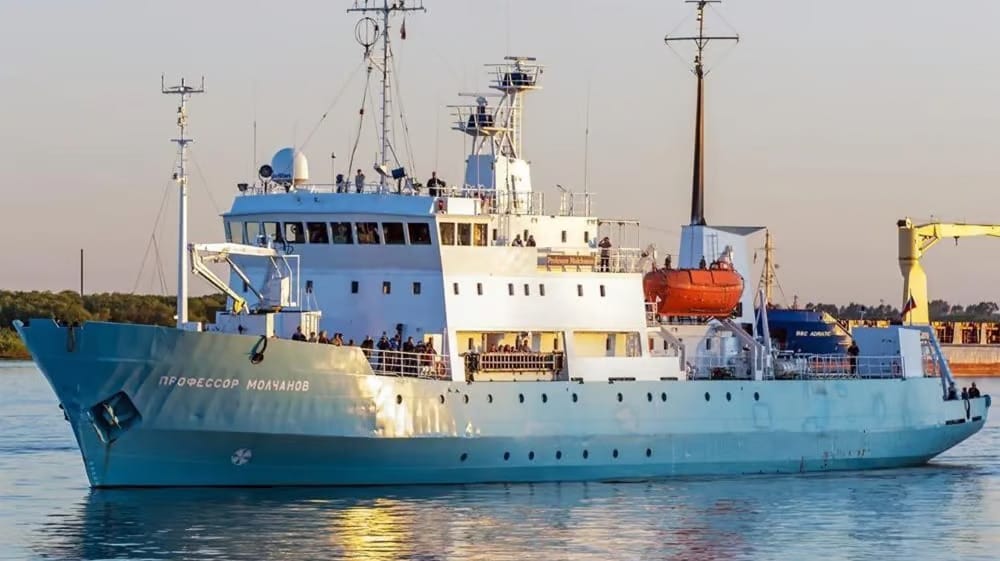
When Norwegian authorities seized the Russian-flagged Professor Molchanov in Svalbard on 2 September, the action initially looked like another expansion of the maritime pressure being applied to Russian shipping.
It was something different.
The vessel does not appear to be individually sanctioned. Instead, its seizure resulted from an attempt by Ukraine's state-owned energy company Naftogaz to enforce a multibillion-dollar international arbitration award against the Russian Federation arising from assets expropriated following Russia's 2014 annexation of Crimea.
That distinction makes the case significant well beyond one ageing Russian ship.
The Governor of Svalbard confirmed that the Nord-Troms and Senja District Court authorised the seizure on 31 August. Acting as the enforcement authority, the Governor subsequently arrested the vessel and ordered it to remain at Barentsburg until otherwise directed by the court or enforcement authorities.
According to Naftogaz, the action forms part of its wider effort to recover approximately $4.22 billion, plus interest and costs, awarded against Russia for the expropriation of Naftogaz Group assets in Crimea.
The arbitral award had previously been recognised as enforceable in Norway.
This created the essential conditions for the seizure: an enforceable judgment, an identifiable Russian state asset and the physical presence of that asset inside a jurisdiction prepared to act.
The movement of the vessel therefore became legally consequential.
Professor Molchanov, IMO 8010348, is a Russian-flagged, ice-strengthened vessel of approximately 1,753 gross tonnes and roughly 72 metres in length.
Built in Finland in 1982 as a specialised Soviet hydrographic and oceanographic research vessel, it was subsequently converted for passenger and expedition operations. The Maritime Executive reports that the vessel has been operating voyages between Murmansk and the Svalbard region since 2025.
Its recent activities have extended beyond conventional tourism. In June 2026, HSE University used Professor Molchanov for an Arctic summer school involving participants from Russia and South Korea. The programme was supported by the Russian state-owned Arktikugol State Trust, which operates Russia's settlements and commercial interests in Barentsburg and Pyramiden.
Naftogaz, however, describes the vessel in particularly important terms: it says Professor Molchanov is owned by the Russian Federation and used for commercial expedition cruises.
The word commercial may become important.
Norway maintains extensive restrictions on Russian shipping. Russian-flagged commercial vessels above specified thresholds have generally been prohibited from entering mainland Norwegian ports since 2022.
But those restrictions contain exceptions, and importantly, the Norwegian government specifically excluded Svalbard from the original port-access prohibition because of the archipelago's distinct international legal framework and Norway's obligations under the Svalbard Treaty.
Research activity also received exemptions within the original Norwegian measures.
Available sanctions-screening information does not currently identify Professor Molchanov itself as a designated vessel.
The ship was therefore able to operate in an environment where Russian maritime access remained possible even as sanctions progressively restricted Russian shipping elsewhere in Europe.
Yet sanctions exposure and asset exposure are not the same thing.
The vessel could legally enter Svalbard and still become vulnerable to a completely different mechanism: civil enforcement against Russian Federation property.
The chain leading to Barentsburg began more than a decade earlier.
Following Russia's annexation of Crimea in 2014, Naftogaz and several affiliated companies pursued compensation for oil, gas and infrastructure assets taken under Russian control. Arbitration proceedings ultimately resulted in an April 2023 award of approximately $4.22 billion.
Russia has not satisfied the award.

Naftogaz has consequently pursued recognition and enforcement proceedings across multiple jurisdictions, seeking Russian Federation assets that can legally be attached.
That changes the relevance of maritime assets.
Ships are mobile. Unlike many other categories of sovereign property, they routinely cross jurisdictional boundaries. A vessel may spend most of its operational life beyond the reach of a creditor and then become exposed simply by calling at a port where the underlying judgment has been recognised.
In the Professor Molchanov case, an Arctic voyage appears to have created precisely that opportunity.
There is also a deeper issue surrounding sovereign immunity.
State property used exclusively for governmental purposes can receive significant protection from enforcement. Commercially employed state property can present a different legal question.
That makes Naftogaz's description of Professor Molchanov as a Russian Federation-owned vessel used for commercial expedition cruises analytically significant.
The vessel's historic designation as a research ship does not necessarily determine how a court views its present function.
What matters increasingly is not simply what a vessel is called, but who ultimately owns it, how it is being used and whether those activities are sovereign or commercial in character.
That is a substantially different form of maritime due diligence from conventional sanctions screening.
The Svalbard seizure points towards a broader consequence of the Russia–Ukraine war.
Maritime enforcement is no longer confined to sanctioned tankers, shadow fleets, prohibited cargoes or vessels suspected of sanctions circumvention. Ships themselves can become financial assets against which judgments and arbitral awards are pursued.
For operators, charterers, insurers, ports and counterparties, that widens the intelligence requirement.
Knowing whether a ship appears on a sanctions list is no longer enough.
The more important questions may increasingly include:
Who ultimately owns the vessel? What judgments exist against that owner? In which jurisdictions have those judgments been recognised? Is the vessel being used commercially? And where is it going next?
The seizure of Professor Molchanov demonstrates why those questions matter.
The ship's voyage to Svalbard was routine.
Its arrival was not.

ASTRA proposes resilient Arabian Sea energy corridors linking Saudi Arabia and Yemen, bypassing vulnerable chokepoints.

From Churchill and Nuuk to Murmansk, Arkhangelsk and Kamchatka, a network of ports, railways and maritime gateways is beginning to reshape the geography of Arctic trade.

Samsung’s CMA CGM claim highlights expanding carrier liability across increasingly integrated global logistics chains.

Bharat Container Shipping Line is part of a wider push into shipbuilding, container manufacturing and inland logistics.